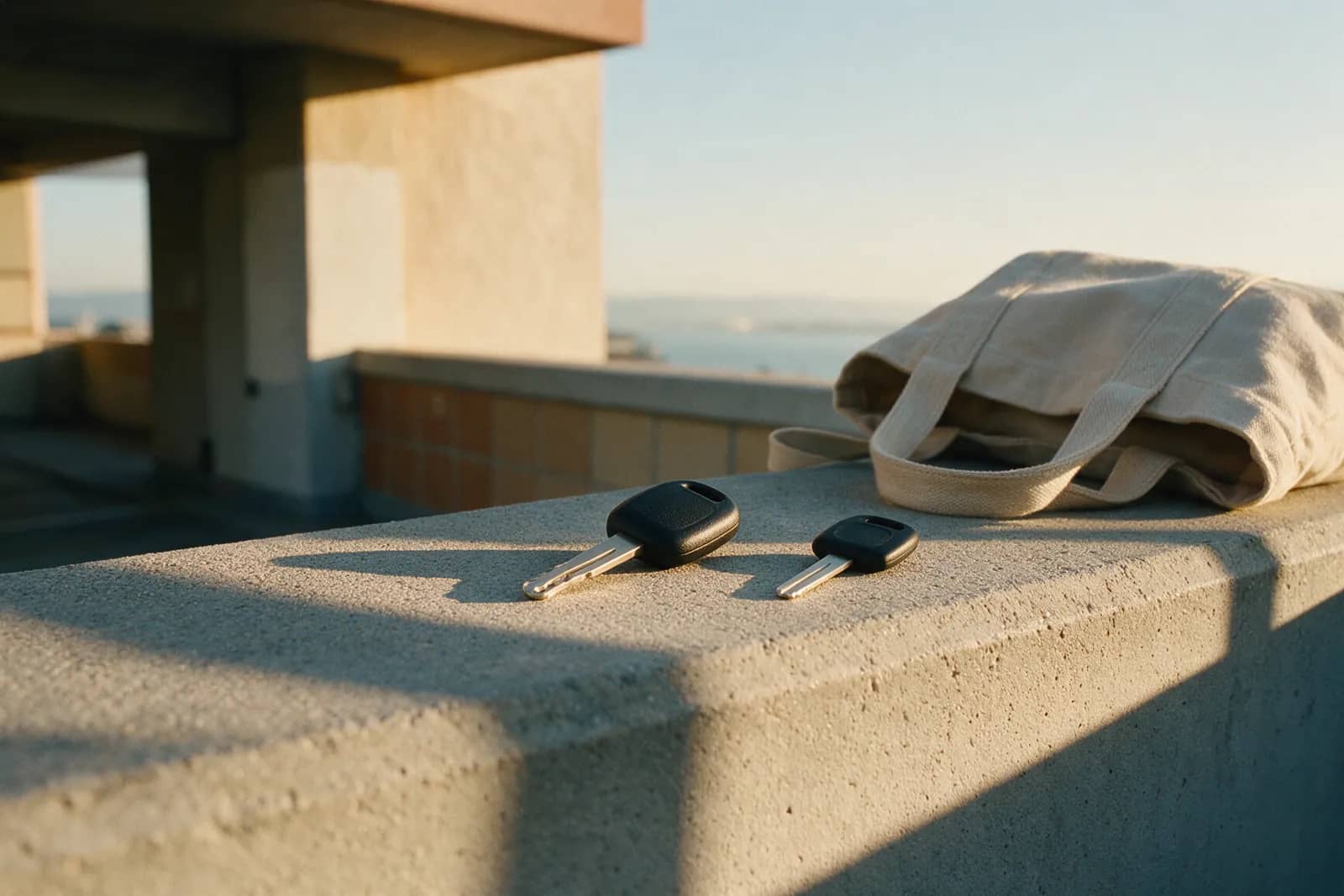
Two places, two clocks
The mall structure and the Caltrain lots produce the same call and run on different clocks. The Hillsdale Shopping Center structure is open while the stores are, and its entrance ramps close a while after they shut; a car still inside then is reachable on foot through a pedestrian door, but the van is not coming up the ramp. The Caltrain lots, at the elevated station by the mall, at Hayward Park on Concar Dr and downtown at 1st Ave, never close. They simply empty after the last train, and the car with the key inside is the only one left under the lights.
Arrival across the city is about twenty-three minutes, and both places are inside that. What the clock changes is the supplement: $45 is added between 8pm and midnight and $75 after midnight, both stated inside the figure on the call. A car lockout is $97 to $179 at any hour, and the range is about the vehicle, not the place.
Saying where the car is
A structure repeats itself. Every level has the same columns, the same ramps and the same light. Before calling, find three things: the level, the store entrance nearest the car, and the column number if the columns are marked. Send a photo of the nearest sign. In a Caltrain lot the equivalent is the row and the number on the nearest pay station or lamp post, and which side of the tracks the lot is on, since the elevated station has parking on both.
Then stay with the car. A technician who reaches level three while you have walked to the food court for a signal loses ten minutes for both of you. If the structure has closed its ramps, say so and say which pedestrian door still opens; the technician parks on the street and walks in with the case, and that is planned rather than discovered.
Locked in, or lost
Two questions on the call decide the job. Can you see the key inside the car, and what is the year, make and model. A key or fob on the seat, in the cupholder or in the trunk with the shopping is a lockout, $97 to $179, and the range reflects the door: an older sedan with a simple linkage opens faster than a new SUV with tight seals and deadlocking that disables the inside handle. A key that is not in the car, dropped somewhere between the platform and the row, is a replacement, $142 to $395, cut and paired to the immobilizer at the car.
Registration or an insurance card with a matching ID is asked for before the door is opened. If those are inside the locked car, say so; the plate is checked against the registration on your phone instead. It is a short step and it is the reason a technician should be willing to open a car in an empty lot at all.
How the door is opened
The standard method uses an inflatable wedge to make a small gap at the top corner of the door, and a long reach tool through the gap to press the unlock button or lift the interior handle. Nothing goes down past the window seal and nothing bears on the glass. It takes a few minutes beside the car. Cars with deadlocking need the button rather than the handle, which is why the model is asked for.
The method to refuse is a coat hanger down the window slot, offered by a helpful stranger or a security guard with good intentions. Modern doors carry the window regulator and the side-impact airbag wiring in exactly the space that sweeps through, and a snagged loom costs several times the opening. Wait for the van whose description and technician's name arrived by text.
The trunk, the hatch and the fob that went quiet
Three variants recur in these two places. The fob went into the trunk with the bags and the lid dropped. Most cars with passive entry refuse to lock with the fob inside, but not all, and not when the fob battery is nearly gone. That is a lockout, and the trunk releases from the cabin once the door opens. The hatch is open and the doors are locked; the cargo area is sealed from the cabin on modern vehicles, and it is still an ordinary lockout.
The third is the fob that worked this morning at the platform and is silent at nine at night in the row. A coin cell on its last week gives up in the cold. Fob programming is $98 to $182, but a new cell is tried first because it is usually the whole answer, and a technician who goes straight to programming has skipped the cheap step.
Getting home, and next time
Payment is card or tap at the car, and the itemized receipt reaches your email before the van leaves the level. If the car cannot be opened that night for a reason the technician explains, ask what the structure does with a car left overnight before you leave it; the answer at the mall is a note on the windshield in the morning, and it is better to know than to guess.
Two habits end most of these calls. Photograph the column or the pay station when you park; it survives a long dinner and a delayed train better than memory. Change the fob battery on a date you will remember. A third costs a little more: a spare key cut in daylight at the same $142 to $395, living at home where the next evening can find it. Hillsdale Lock & Key writes the figure down on the call, texts the technician's name and a thirty-minute window, opens without damage first and takes card or tap at the car with an itemized receipt that matches the work order.
Quick answers
The structure has closed. Can the technician still reach my car?+
Yes, on foot. The van parks on the street and the technician comes in through the pedestrian door you name. Say which door still opens and which level the car is on, and the walk is planned on the call rather than found at the ramp.
What does a car lockout cost in the evening?+
$97 to $179 depending on the vehicle, with $45 added between 8pm and midnight or $75 between midnight and 7am. The $89 service call is inside that figure, and the total is written down on the call.
The fob is in the trunk and the car locked anyway. Is the fob broken?+
Probably a low battery. A car that refuses to lock with the fob inside will lock when it can no longer hear it. The door is opened as an ordinary lockout, the trunk releases from inside, and a fresh coin cell is tried before anything is programmed.
Need it handled rather than read about?
(650) 532-7959More guides